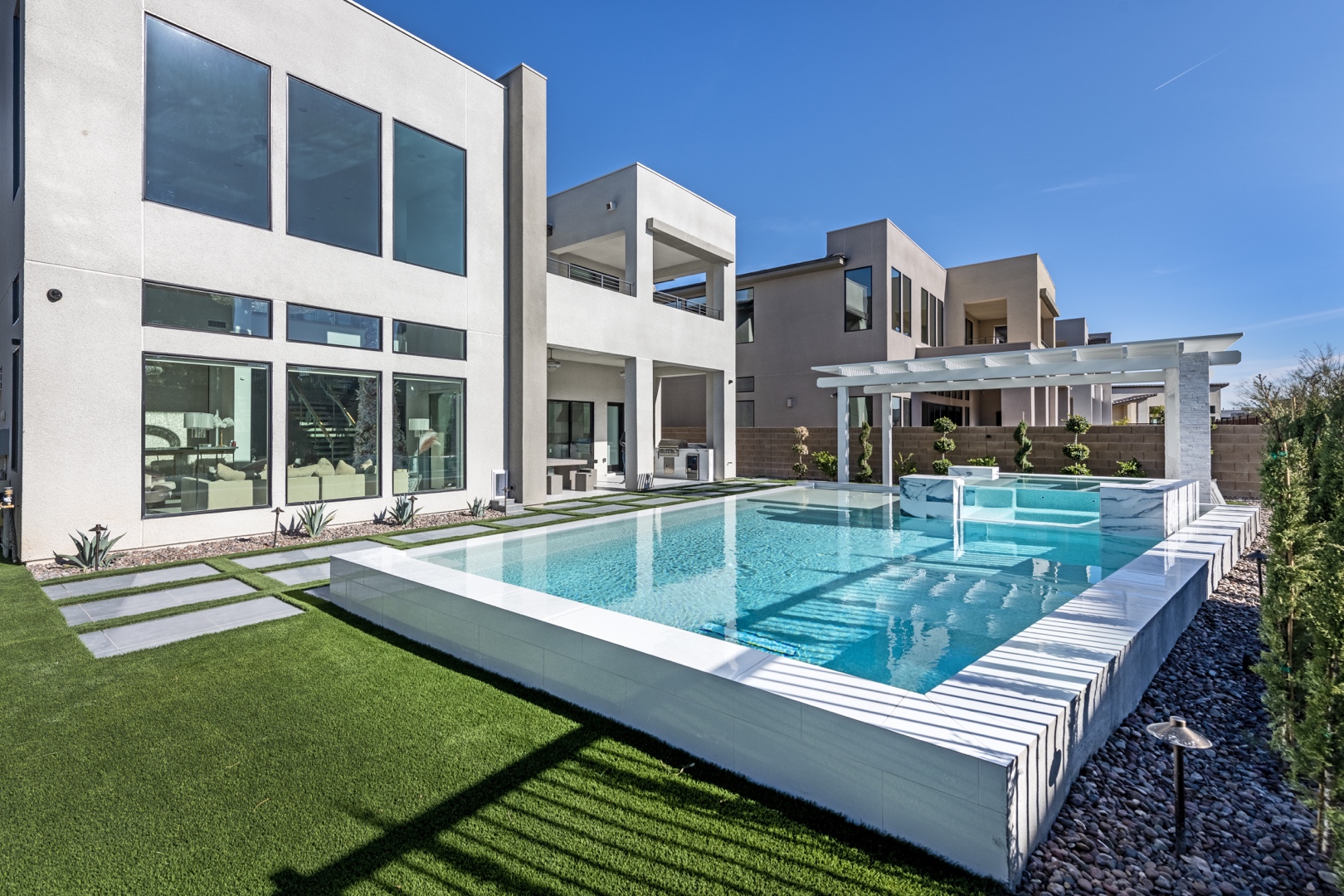
A luxury pool should create an effortless outdoor experience, not send water toward the home after a monsoon storm or leave a patio slick after a busy weekend of entertaining. To plan backyard pool drainage properly in Las Vegas, drainage must be considered as part of the entire outdoor environment: pool elevations, decking, roof runoff, walls, planting areas, and the property’s approved discharge strategy all need to work together.
For a custom outdoor living project, drainage is not an accessory added after the pool is complete. It is a construction decision that protects masonry, finishes, landscaping, and the home itself for years to come.
Start Backyard Pool Drainage Planning Before Design Is Final
The most effective drainage solutions begin with a careful site assessment. A professional team evaluates the property’s existing grade, the elevation of the home, lot boundaries, neighboring properties, utility locations, roof drainage, soil conditions, and any existing drainage easements or swales. In Las Vegas, an otherwise dry landscape can receive intense, fast-moving stormwater during a monsoon event. The system has to account for those peak conditions, not only ordinary irrigation runoff.
Pool placement affects every subsequent drainage decision. A pool shell, raised spa, sunken seating area, retaining wall, outdoor kitchen, and patio each create new surfaces that alter where water travels. If these elements are designed independently, water may collect at transitions, run toward door thresholds, or become trapped between walls and decking.
A master-planned approach establishes finished elevations before construction begins. The pool deck should generally pitch away from the pool where appropriate and direct surface water toward intentional collection points. At the same time, the design must preserve comfortable access, clean architectural lines, and the level surfaces required for furniture, dining, and circulation. Drainage cannot be solved by simply making everything slope more aggressively.
Separate Pool Water From Stormwater
A backyard pool has several water sources, and each requires a different response. Rainfall on decking, roof runoff, irrigation overspray, pool splash-out, and water released through the pool’s overflow system should not be treated as one undifferentiated problem.
Pool overflow is particularly important. When rainfall raises the water level, an overflow system helps prevent water from spilling randomly over the coping and onto surrounding surfaces. The overflow line must be properly integrated into the pool’s plumbing and coordinated with local requirements. It is not a substitute for deck drainage, however. A well-designed overflow can manage excess pool water while storm drains, channel drains, area drains, and grading address water falling on the rest of the backyard.
This distinction matters around high-end finishes. Natural stone, porcelain pavers, decorative concrete, and custom masonry can all perform beautifully when installed over an appropriate base with controlled drainage. Persistent standing water, by contrast, can contribute to staining, settlement, efflorescence, slippery surfaces, and premature deterioration at joints or edges.
Design the Grade Around the Pool and Patio
Positive drainage means water is directed away from structures and other vulnerable areas rather than allowed to pond beside them. The exact slope depends on the material, site conditions, access requirements, and local code considerations, but the principle is consistent: every hardscape surface needs a deliberate path for water.
Around a pool, grading must balance several priorities. Decking should feel visually level and safe underfoot, yet water needs a route away from the house, patio doors, outdoor kitchen cabinetry, and low-lying landscape areas. Where a broad patio meets a raised planter or retaining wall, the design may need a linear drain at the transition. Where a side yard naturally carries water toward the rear yard, subsurface drainage or a carefully engineered swale may be necessary.
The best solution depends on the property. A flat lot may rely more heavily on drain inlets and underground piping. A sloped lot may need retaining walls, terraced elevations, and controlled surface channels. On some properties, the most attractive drainage feature is nearly invisible. On others, a properly detailed rock-lined swale can complement a xeriscape palette while slowing and guiding water through the landscape.
Protect the Home’s Perimeter
The home should remain the primary reference point in drainage planning. New pool decking must not create a reverse slope that sends water toward the foundation. Door thresholds, weep screeds, exterior wall finishes, HVAC equipment, and utility penetrations all deserve attention during the design phase.
Roof runoff also deserves coordination. Downspouts that currently discharge onto a future pool deck, into a narrow side yard, or beside an outdoor kitchen can overwhelm even a well-graded patio. Extending, capturing, or rerouting roof drainage may be part of the larger solution. This work should be planned before decorative finishes are installed, not after water reveals the problem.
Choose Drainage Components for Performance and Appearance
Premium outdoor environments should not look like a collection of exposed utility parts. Fortunately, drainage components can be selected and detailed to support both performance and the project’s design language.
Linear channel drains are often effective at patio-to-wall transitions, along the front of a raised structure, or where large paved areas need a discreet collection point. Their grates are available in profiles and finishes that can coordinate with modern architecture, stone, tile, or concrete. Area drains can serve localized low points, while catch basins help collect sediment before it enters underground piping.
Subsurface drain systems may be appropriate behind retaining walls, around planter areas, or in locations where groundwater and irrigation could create pressure against masonry. These systems are hidden, but their installation is highly consequential. Proper aggregate, filter fabric, pipe placement, cleanouts, and outlet routing determine whether the system continues to function as intended.
A drainage plan may include several elements:
- Surface grading that moves water toward planned collection areas
- Channel or area drains at vulnerable hardscape transitions
- Underground piping sized for anticipated runoff and connected to an approved outlet
- Retaining-wall and planter drainage that relieves water behind masonry
- Pool overflow plumbing that is distinct from deck and stormwater drainage
The right combination is driven by the site, not a standard package. An expansive estate with multiple outdoor rooms and elevation changes requires a different strategy than a compact courtyard pool, even when the visual style is similar.
Coordinate Drainage With Xeriscape and Irrigation
Water-smart landscaping is an important part of drainage performance in the Las Vegas valley. Desert-adapted plant material, properly contoured planting areas, decorative rock, and efficient irrigation reduce unnecessary runoff while preserving a refined, finished appearance.
Xeriscape does not mean covering the yard in rock and hoping water disappears. Planting beds need proper soil preparation, irrigation zoning, and edges that prevent water from washing mulch or decorative aggregate onto the pool deck. In selected areas, landscape basins can temporarily receive stormwater and allow it to disperse gradually. These features should be sized and located carefully so they do not undermine walls, saturate root zones, or interfere with usable outdoor space.
Irrigation must also be tested after installation. Overspray onto decking can mimic a drainage failure, leave mineral deposits on finishes, and create slippery conditions. Drip irrigation, correct emitter placement, and separate hydrozones give the landscape the water it needs without adding avoidable water to paved areas.
Include Permits, Engineering, and Construction Sequencing
A drainage plan is only as reliable as its execution. Pool excavation, plumbing, electrical work, steel, decking, walls, and landscape construction occur in a specific order. If elevations are not established and verified throughout the process, a small deviation early in construction can create a costly correction once finished materials are in place.
Experienced design-build management brings drainage into the engineering and permitting conversation from the beginning. Depending on the scope and jurisdiction, plans may need to address drainage routing, grading, retaining structures, property-line conditions, and code requirements. Construction supervision then confirms that drain lines, sleeves, cleanouts, and collection points are installed before concrete, pavers, or stone conceal them.
This is one reason a cohesive project team provides meaningful value. The pool contractor, masonry crew, landscape installer, and irrigation specialists should be building from one coordinated set of elevations and details. Green Planet Landscaping & Pools approaches outdoor environments as connected systems, helping clients avoid the compromises that occur when separate features are designed and installed in isolation.
Plan for Service Access and Long-Term Care
Even an expertly installed drainage system needs occasional attention. Leaves, desert dust, landscaping debris, and fine sediment can collect in grates and catch basins. Drains should be accessible for inspection and cleaning without removing major sections of hardscape or disturbing established planting.
Before finalizing the design, ask where drain cleanouts will be located, how water will exit the system, and whether future service can occur without affecting the pool deck or outdoor furnishings. These practical details are easy to overlook in a rendering, yet they protect the investment behind it.
A beautiful backyard earns its value through how confidently it performs. When drainage is planned alongside the pool, hardscape, landscape, and architecture, rainwater becomes a managed part of the property rather than an unwelcome surprise after the first major storm.