A custom pool in Las Vegas is rarely just a pool. It is often the centerpiece of an outdoor living environment built for long summer days, evening entertaining, family time, and the distinctive architecture of the home. So, how much does a custom pool cost in Las Vegas? For a professionally designed and constructed in-ground pool, many homeowners should expect an investment starting around $75,000 to $100,000, with comprehensive luxury pool environments commonly ranging from $150,000 to $300,000 or more.
The final number depends less on a single price-per-square-foot formula than on the scope of the environment being created. Pool size matters, but so do engineering, access, soil conditions, finishes, water features, spa integration, decking, equipment, permitting, and the level of customization required to make the entire backyard feel intentional.
Typical Custom Pool Costs in Las Vegas
A straightforward custom pool with a clean geometric shape, quality plaster finish, standard equipment, required safety features, and modest decking may begin in the lower end of the custom market. That does not mean it is a simple undertaking. Even a restrained design requires excavation, structural steel, shotcrete, plumbing, electrical work, equipment installation, interior finish work, inspections, and careful coordination with local code requirements.
Once a pool incorporates a raised spa, upgraded tile, automated controls, energy-efficient variable-speed equipment, larger deck areas, or a more complex shape, the investment rises quickly. A mid-range custom pool project commonly lands between $100,000 and $175,000, particularly when the homeowner wants a finished setting rather than a pool placed into an otherwise unfinished yard.
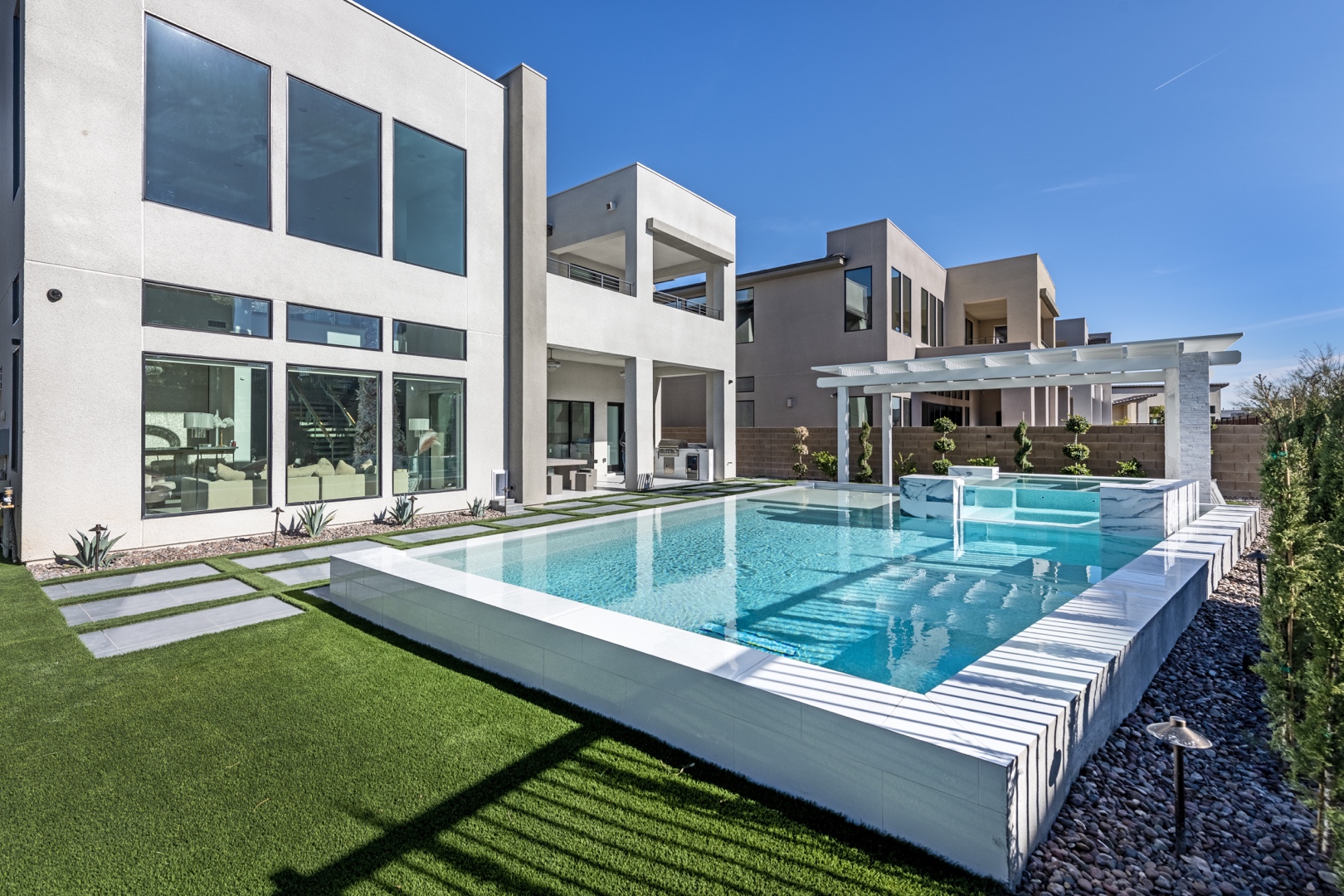
At the high end, the project becomes a master-planned outdoor living space. These properties may include an infinity edge or perimeter overflow detail, fire and water features, custom masonry, outdoor kitchens, covered patios, integrated landscape lighting, premium stone, mature specimen planting, and water-conscious xeriscape. In that category, budgets of $200,000 to $400,000 and beyond are realistic depending on the property and architectural vision.
What Drives the Cost of a Custom Pool?
Size, depth, and structural complexity
A larger pool requires more excavation, steel, concrete, plumbing, water, finish material, and labor. Depth also affects structural requirements and excavation quantities. While homeowners often begin by comparing dimensions, two pools with the same footprint can have very different costs when one includes a deep-end configuration, a tanning ledge, multiple elevations, or a highly detailed freeform layout.
Las Vegas properties can also present site-specific conditions that affect construction. Tight side-yard access, retaining requirements, existing utilities, challenging grades, demolition, and limited space for equipment can all increase labor and coordination. A responsible proposal accounts for the actual property rather than relying on a generic online estimate.
Spa, water features, and visual impact
A spa is one of the most popular additions to a Las Vegas pool, especially for homeowners who want to use the backyard through cooler months. It also adds structural work, plumbing, heating capacity, controls, tile, and finish details. A raised spa with a spillway creates an elegant focal point, but it is more involved than an attached, flush-level configuration.
Water features can range from simple deck jets to architectural scuppers, rain curtains, sheer descents, grottos, and dramatic fire-and-water elements. These details have a meaningful effect on atmosphere, but each requires specialized plumbing, electrical coordination, masonry, and long-term service considerations. The best feature is not necessarily the largest one. It is the one that fits the home’s architecture, sounds appropriate for the setting, and contributes to the way the space will be used.
Interior finishes, tile, and coping
Material selections are where a custom pool begins to establish its character. Standard plaster finishes provide a beautiful, durable foundation, while premium pebble finishes, glass tile, porcelain tile, natural stone coping, and carefully selected waterline tile can elevate the appearance substantially.
These choices should be evaluated for more than appearance. Las Vegas sun exposure, heat, pool chemistry, slip resistance, maintenance expectations, and the relationship between materials all matter. A pale stone coping may suit a desert-modern home beautifully, for example, but material selection should also consider surface temperature and durability in extreme conditions.
Equipment, automation, and efficiency
Pool equipment is often overlooked in early budgeting because it is largely out of sight. It has a direct effect on operating costs, convenience, water quality, and future maintenance. Variable-speed pumps, efficient filtration, automated valves, remote controls, LED lighting, saltwater systems, and appropriately sized heaters add to upfront cost while improving ownership over time.
For a pool and spa combination, the heating strategy deserves particular attention. The equipment must be properly sized for the pool volume, spa use, desired recovery time, and the homeowner’s expectations. Selecting equipment solely to reduce the initial contract amount can create frustration long after construction is complete.
Why the Backyard Scope Changes the Budget
The most accurate answer to how much a custom pool costs in Las Vegas includes the area around the water. A pool placed beside minimal concrete serves one purpose. A complete outdoor environment serves many: cooking, dining, conversation, shade, relaxation, play, and year-round visual enjoyment from inside the home.
Decking is a major budget consideration because it defines circulation, furniture placement, and the sense of scale around the pool. Decorative concrete, porcelain pavers, natural stone, and custom masonry each carry different costs and maintenance profiles. Covered structures, outdoor kitchens, fire features, landscape walls, drainage improvements, lighting, planting, and irrigation-conscious xeriscape can transform the project, but they should be planned together rather than added as disconnected afterthoughts.
This integrated approach can also protect the investment. Planning utilities, drainage, structural elements, lighting zones, and material transitions before construction begins helps avoid costly revisions and awkward compromises later.
Permits, Engineering, and Construction Standards
Las Vegas pool construction involves more than design preference. Permitting, property setbacks, safety barriers, electrical requirements, drainage considerations, and structural documentation all influence the process and, in some cases, the project cost. Properties governed by an HOA may also require architectural review before work begins.
A qualified design-build contractor will evaluate these requirements early, prepare the necessary drawings, coordinate permits, and manage inspections throughout construction. This level of planning is especially valuable for complex projects involving elevated spas, retaining walls, shade structures, kitchens, or features that require several licensed trades.
Green Planet Landscaping & Pools approaches pool projects as coordinated outdoor environments, using detailed design visualization, engineering documentation, permitting management, and skilled construction supervision to bring the entire vision into alignment. For a significant property investment, that single point of accountability matters.
How to Budget for the Right Pool Project
Begin with how you want to live outdoors, not with a list of isolated features. Consider whether the backyard is primarily for quiet relaxation, children and grandchildren, large-scale entertaining, fitness, or a combination of uses. Then decide which components are essential on day one and which can be phased without disrupting the completed work.
Be clear about your comfort range, but leave room for site conditions and meaningful upgrades. A well-designed pool environment can be built in phases, yet foundational items such as plumbing sleeves, electrical conduits, equipment capacity, drainage, and structural preparation should be considered from the start. It is far more efficient to prepare for a future outdoor kitchen or fire feature during initial construction than to cut into finished decking later.
Ask each contractor what is included in the proposal. Clarify allowances for finish materials, tile, coping, decking, equipment, permits, demolition, drainage, landscaping, and startup service. A lower initial figure may omit essential components that will ultimately be necessary to complete the backyard properly.
The right custom pool budget is not simply the lowest construction number. It is the investment required to create a durable, code-compliant, beautifully resolved environment that feels like it was always meant to belong to your home. A thoughtful design consultation is the best place to turn that vision into a practical, well-defined plan.