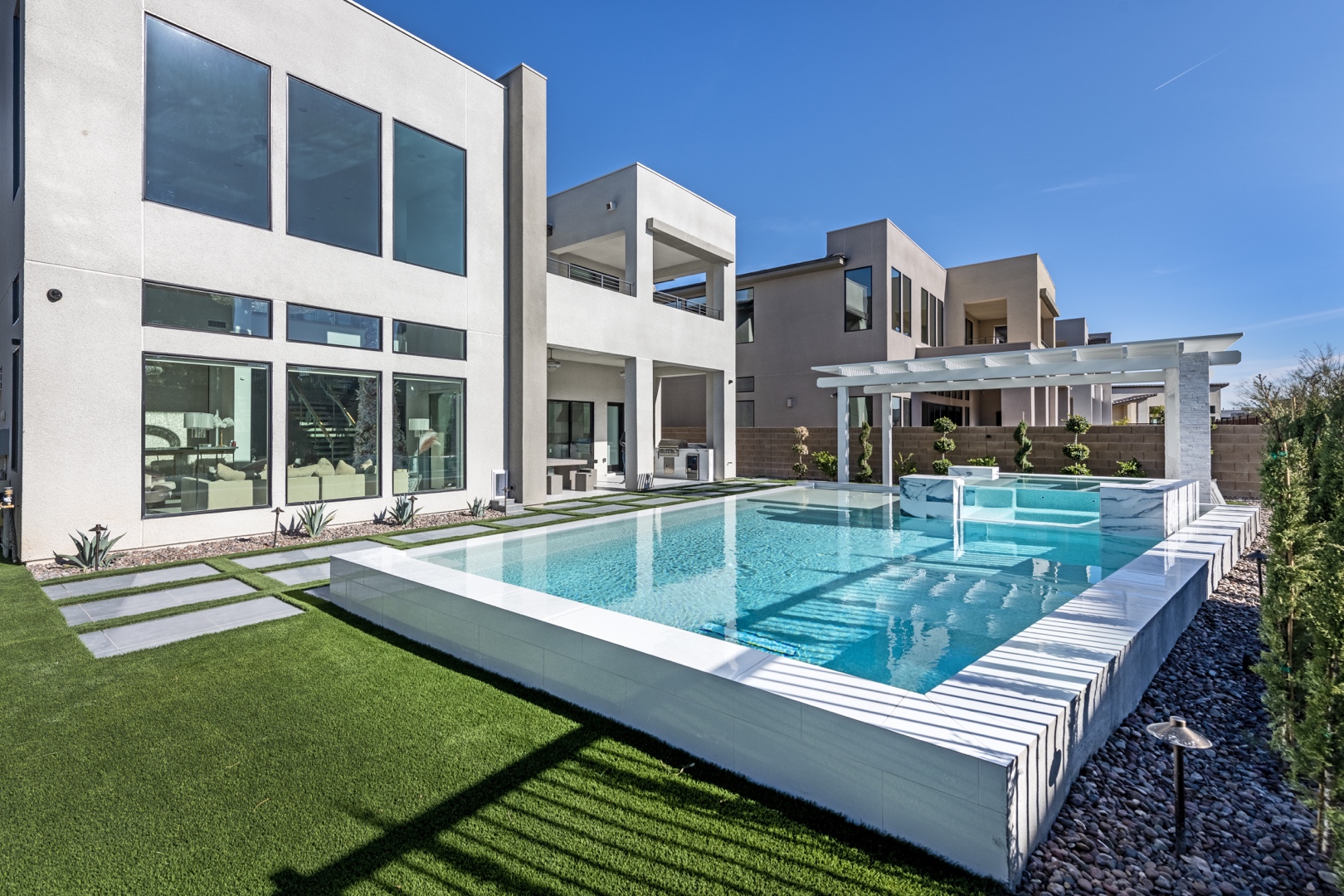
A pool tile selection can look perfect in a showroom and feel entirely different under the Las Vegas sun. Glare, reflected heat, hard water deposits, splash patterns, and the scale of the pool all change how a material performs and how it is perceived. The best pool tiles are not simply the most expensive or most decorative option. They are the tiles that support the architecture, remain practical to maintain, and give the water a finish that feels intentional from every vantage point in the backyard.
For a custom pool environment, tile should be considered early in the design process, alongside coping, deck materials, water features, lighting, and adjacent landscape. This is how a pool becomes part of a complete outdoor living environment rather than a collection of unrelated finishes.
What Makes the Best Pool Tiles Different?
Pool tile has real work to do. At the waterline, it protects the pool shell from the residue left by evaporation, sunscreen, body oils, and minerals. In a spa, it must handle warmer water and more concentrated chemistry. On a tanning ledge, step, or raised wall, it becomes a highly visible architectural surface that needs to be safe as well as attractive.
The right selection begins with technical suitability. A tile rated for submerged applications is essential, particularly in a pool or spa. It should have low water absorption, be compatible with the specified installation system, and be installed with materials designed for a chemically treated aquatic environment. These details are not glamorous, but they influence whether a finish remains secure, cleanable, and refined over time.
Appearance comes next. The same tile can read cool blue, vivid turquoise, deep green, or nearly black depending on water depth, interior finish color, sunlight, and surrounding materials. A large open pool with pale decking often benefits from a tile that introduces depth and definition. A compact courtyard pool may need a quieter finish so the space does not feel overly busy.
Glass Tile: Luminous, Detailed, and Demanding
Glass tile is often chosen for luxury pools because of its light-reflective quality. It can give water a jewel-like surface, create movement along a waterline, and make spillways or raised spa walls feel like focal points after dark. In shades of blue, aqua, charcoal, pearl, or mixed metallic tones, glass can deliver a level of visual depth that few materials can match.
It is especially effective in controlled applications: a waterline band, a negative-edge wall, a spa spillway, or a carefully composed water feature. Full glass-tile interiors can be spectacular, but they are a significant investment and require exacting substrate preparation, setting materials, installation, and ongoing care.
Las Vegas homeowners should also consider glare. Highly reflective glass may be beautiful in a shaded showroom but intense across a large west-facing pool. A textured blend, a matte component, or a more restrained color variation can produce a sophisticated finish without excessive sparkle. The best choice depends on the pool orientation, the amount of direct sun, and the desired mood of the entire space.
Porcelain Tile: Versatility With Strong Performance
Porcelain is one of the most adaptable choices for waterlines, steps, spas, and poolside architectural details. It is dense, durable, available in a broad range of sizes and colors, and often provides a more restrained, contemporary appearance than glass. It can resemble natural stone, concrete, handcrafted ceramic, or a clean monolithic surface while offering predictable performance in wet conditions.
For clients who want a modern desert-resort aesthetic, large-format porcelain on raised walls or an adjacent outdoor kitchen can visually connect the pool to the rest of the hardscape. Smaller porcelain mosaics are also useful for curves, benches, and steps where a larger tile would require too many cuts.
Not every porcelain tile is appropriate for every location. A wall tile may not have the slip resistance or thickness needed for a deck, and a beautiful polished surface may be unsuitable for a wet step or shallow ledge. Tile specifications should reflect the exact application, not just the desired look.
Natural Stone: Beautiful, but Use It Selectively
Natural stone has a warmth and individuality that manufactured materials rarely duplicate. Limestone, travertine, quartzite, and certain dense stones can work beautifully around pools, particularly when the goal is a timeless, resort-inspired outdoor setting. Stone is often strongest as coping, decking, wall cladding, or a water-feature surround rather than as submerged tile.
The trade-off is maintenance and material variation. Some stones are porous, prone to staining, or vulnerable to chemical exposure and repeated wet-dry cycles. Others can become hot underfoot in direct desert sun. Proper material selection, sealing where appropriate, drainage planning, and realistic maintenance expectations are essential.
A light-colored, heat-conscious stone may be ideal for a pool deck, while a frost-resistant porcelain or glass tile handles the waterline. This combination often provides the character of natural materials without asking one product to perform beyond its strengths.
Choosing Waterline Tile for Las Vegas Conditions
Waterline tile deserves particular attention because it is both functional and visible. The waterline is where evaporation leaves mineral deposits, and Southern Nevada’s hard water can make a high-contrast tile difficult to keep looking pristine. Very dark, glossy finishes may show calcium residue more readily than mid-tone or variegated selections. That does not make them a poor choice, but it does mean the maintenance plan should match the finish.
A tile with tonal movement can be forgiving while still looking tailored. Blue-gray mosaics, soft green blends, warm neutrals, and textured porcelain can complement the desert palette while helping minor deposits disappear visually between routine service visits. The grout color matters as well. A thoughtfully selected grout can make a tile field look crisp and continuous, while an unsuitable color can turn a refined finish into a visible grid.
The waterline should also relate to the pool interior. A pale interior finish with deep navy tile creates dramatic contrast. A medium-blue interior paired with blue-green mosaics delivers a more immersive water color. Charcoal tile against a light plaster can feel architectural and modern, especially when repeated on a raised spa or fire feature wall.
Consider the Full Material Palette
A pool is rarely viewed in isolation. From inside the home, the eye may take in water, tile, coping, decking, planting, shade structures, and outdoor furnishings in one composition. The most successful tile selections reinforce that composition.
If the home has warm stone veneers and bronze metalwork, an icy silver-blue tile can feel disconnected unless it is repeated elsewhere. If the architecture is crisp and contemporary, rustic multicolor stone may compete with clean lines. The aim is not to match every material exactly. It is to establish a controlled relationship between undertones, texture, scale, and contrast.
At Green Planet Landscaping & Pools, Inc., tile is evaluated within the larger master plan, using detailed design documentation and visualizations to help clients see how finishes will relate before construction begins. That level of planning is particularly valuable when a pool includes a spa, vanishing edge, water feature, fire elements, or multiple hardscape zones.
Safety and Installation Are Part of the Finish
Luxury should never come at the expense of safe movement around water. Steps, swim-outs, baja shelves, and spa entries need materials with appropriate traction. Small-format mosaics can be an excellent solution because the additional grout joints provide grip on curved or submerged surfaces. On surrounding decks, the selected paver or porcelain should be evaluated for wet slip resistance and surface temperature.
Installation quality matters just as much as the tile itself. Pool tile systems require sound substrates, correct waterproofing or crack-isolation methods where specified, proper movement joints, compatible setting materials, and careful attention to transitions. Water features and spillways deserve special scrutiny because even slight alignment issues become noticeable when water runs across the finished surface.
A high-end tile should look deliberate at corners, returns, drains, steps, and the edge where water meets stone. Those are the details that distinguish a carefully built pool from one that merely photographs well on installation day.
A Better Way to Make the Final Selection
Start with how you want the water to feel: calm and reflective, bright and tropical, dark and dramatic, or soft and resort-like. Then consider the view from the home, the pool’s sun exposure, expected maintenance, and how tile will interact with the decking and architecture. Request samples large enough to evaluate outdoors, near the proposed coping and interior finish, at different times of day.
Do not let a small sample make the entire decision. A two-inch mosaic chip cannot fully show the effect of a full waterline, a broad raised wall, or a tiled spa spillway. Scaled visualizations, material boards, and experienced construction guidance make it easier to invest confidently in a finish that will remain beautiful long after the project is complete.
The right tile gives a pool its signature, but its greatest value is how naturally it supports the life around it: quiet mornings by the water, evenings with guests, and a backyard that feels considered from the first step outside.